Monday, October 18, 2010


Vito Acconci, Following Piece, 1969


Sophie Calle, The Shadow, 1981: "In April 1981, at my request, my mother went to a detetctive agency. She hired them to follow me, to report my daily activities, and to provide photographic evidence of my existence."


Jeff Wall, The Destroyed Room, 1978


Henry Darger, from The Story of the Vivian Girls 


Roni Horn, Dead Owl, 1998


Giuseppe Penone working on an Atlas Cedar, 1999


Shana Lutker, Dream Book, 2003-2004


Las Meninas, by Michel Foucault (Required reading)

Also, a
profile of Baldessari by Calvin Tompkins was published in the New Yorker last week in anticipation of the opening of Pure Beauty at the Met October 20.


Last week we talked about the role of narrative in art history and about various narrative strategies. The images above include works that are based around blurring the boundaries between fiction and reality in storytelling. Many of the two-dimensional works include more than one panel or page, in order to directly address the perception of a linear passage of time, something that is often fundamental in narratives. Some are more performative and are experienced by the viewer either as an image with text, as a text alone, or as a sculpture. 


Do you think that it's possible to tell a story using a single image or object?


Also, can you think of any examples of current non-filmic work that employs narrative?

Monday, October 11, 2010


Caravaggio, St. Jerome Writing, c 1600


Diego Velasquez, Old Woman Frying Eggs, 1618


Diego Velasquez, The Waterseller at Seville, 1623

This week we saw high-contrast chiaroscuro in Jarman's "Caravaggio," and talked about the cinematic drama of baroque painting and how it functioned for a struggling Catholic church. The paintings and sculptures at the end of the renaissance and into the baroque began to favor dynamism over classical symmetry and depictions of flesh over divine iconography. 


Why do you think that in the baroque paintings we've looked at (and those above) perspective has become such a secondary strategy?


Also, we talked about the anachronistic props in the film at the end of class. Can you think of other examples of films or artworks that incorporate techniques, styles, or subjects from various time periods--and to what effect?

Sunday, October 3, 2010


Caravaggio, The Taking of Christ, 1602


Caravaggio's bones? / June 2010

Getting ready for the Baroque, a look at Caravaggio. The reading for this week: Paul Schrader, Notes on Film Noir (from Silver and Ursini's Film Noir Reader).

Friday, October 1, 2010


Fra Angelico, Annunciation, 1438-45


Sandro Botticelli, Primavera, c. 1482


James Turrell's Live Oaks Friends Meeting House, 2000


This week we discussed the transition from the Gothic to the Early Italian Renaissance period in both architecture and painting. A renewed interest in Classical antiquity and the development of linear perspective related to highly developed ideals of geometric symmetry. The interest that wealthy patrons like the Medici's took in art was also a critical factor in the dedication of resources to artistic practice and production.

The illusion of light and space became important strategies for artists working in the period, although traditional symbolism remained in play, and this illusion has continued to resonate through architecture, theater, dance, and art for centuries. This week there are two discussion questions. 


Did perspective allow artists to depict spatial reality more accurately? 

In this period, the role of the artist was elevated. Remember that icons were considered to be of divine origin, not created by human work. Do you think that the model of church and lay patronage was freeing or limiting for artists? How does it relate to art practices today?

Sunday, September 26, 2010


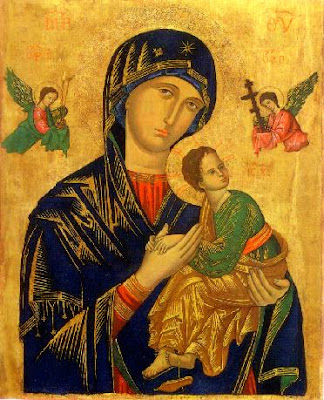
Byzantine icon Our Lady of Perpetual Succor (circa 1400)


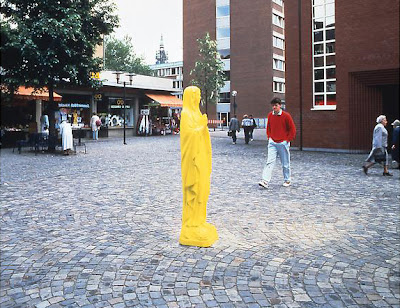
Katharina Fritsch, Madonnenfigur, 1987


Rauschenberg's Erased De Kooning Drawing, 1953


The Vasari reading for the week is online here. Next class we will 
discuss the illusion of light and space. 


In class, Tom talked about religious icons, reinterpretations of iconic 
practices, and religious and secular iconoclasm. Historically, an icon 
was a likeness or representation considered to have a divine provenance. 
After the lecture, how would you define an icon today? Can you think 
of any examples of contemporary iconoclasm in relation to 
contemporary icons? 

Wednesday, September 22, 2010

Tomorrow in class we are going to look at and discuss icons, both ancient and contemporary. Do you have any thoughts about who creates or defines an icon? Respond here or just keep this question in mind to prepare for class.

Monday, September 20, 2010


Roy Lichtenstein


This week's recommended reading: Chapter 1 from Arthur Danto's After the End of Art, Princeton, 1997

And, Roberta Smith reviewed Dan Colen's work last week
here.

Thursday, September 16, 2010

Welcome to the class! Check back soon for the Arthur C. Danto reading and an electronic version of the syllabus.